“There’s a clear structure. Everything is taken care of for teachers. They can now think about the things that matter.”
That’s what one subject lead told us during a recent school visit. Simple, yes – but also one of the strongest endorsements a curriculum can receive.
When teachers stop asking for help, it’s not always a red flag. Sometimes, it’s a sign your curriculum is finally doing the heavy lifting.
Too often, English leads are expected to operate as walking encyclopaedias. Planning a narrative unit? Ask the English lead. Unsure how to model sentence structure? Go find the English lead. Need help sequencing grammar? Pop into the English lead’s classroom.
The result? Leadership fatigue. Teacher dependency. Patchy inclusion.
That’s why moments of genuine independence matter. When a curriculum is structured, coherent and still allows room for professional judgement, it reduces pressure and builds confidence.
What schools are telling us
Across schools introducing Leading English, three themes keep surfacing:
Increased confidence
Teachers rely less on the subject lead. There’s more clarity and independence and more space to teach well.
Improved outcomes
There’s more writing happening. Pupils are producing more and quality is rising. Not because of gimmicks, but because the journey is clearer.
Real flexibility
Experienced teachers adapt model texts with purpose. Early career teachers thrive with structure. Everyone shares the same foundation.
This isn’t a revolution. It’s a return to teaching as a craft – with the right tools in the right places.
What’s actually working
Here are some of the high-leverage moves making a difference in real classrooms:
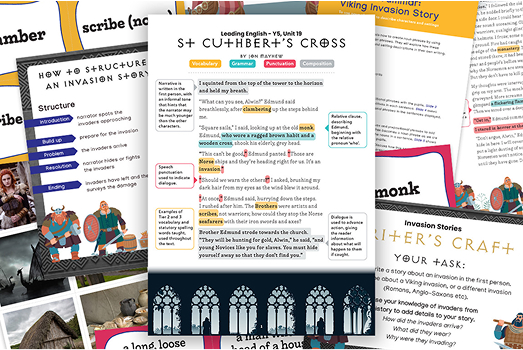
Medium-term plans as the game changer
Teachers aren’t forced to design a sequence from scratch. Plans are detailed enough to guide, flexible enough to adapt and intentional in progression.
Grammar taught in context
Grammar isn’t bolted on. It’s embedded in model texts, connected to vocabulary and tied to writing outcomes. Teachers talk about it more because they can see its purpose.
Vocabulary support with depth
One school used picture-symbol widgets alongside vocabulary cards. The impact? Stronger access for EAL and SEND pupils.
Consistent shared and modelled writing
There’s a cohesion to teaching. Even when model texts are adapted, learning intentions stay stable – and that consistency is powerful.
12 questions to build curriculum confidence
Use these for planning, coaching or reflective discussions.
Planning & sequencing
- What key learning do we want to develop and what writing outcome will show it?
- Where will oral rehearsal have the biggest impact?
- Which scaffold will support without doing the thinking for pupils?
- Where might the grammar step need more modelling?
Vocabulary & grammar
- Which Tier 2 words will unlock deeper thinking?
- How will pupils use vocabulary in context rather than isolation?
- Where does grammar build purposefully into the writing?
- Could sentence stems increase fluency and confidence?
Feedback & assessment
- What’s one redrafting focus that will deepen writing?
- Where can live feedback shape outcomes before pupils finish?
- What does success look like beyond correctness – fluency, stamina, independence?
- How will we know pupils are thinking like writers, not just complying?
Practical moves you can start this week
These actions are working well across schools – especially for inclusion:
- Start every planning meeting with: “What do our lowest attainers need in this unit?”
- Use curriculum visuals (grammar progression, unit overviews) to anchor CPD.
- Print model texts with annotations and discuss how they support oracy, grammar and structure.
- Celebrate scaffolded success in briefings: “This sentence stem helped X pupil extend their ideas confidently.”
- Choose one grammar step and track it over a week. Where did it land best – and why?
- Create a “Talk Moves” poster to support structured oracy.
- Use assessment week to compare current writing with last term. What routines helped?
Ask a colleague to observe your modelling for five minutes and share one insight back.
Leading English can help you build a writing offer that’s inclusive, coherent and confident.