Improving writing across a whole school is rarely about one single change. It’s not simply about purchasing a new scheme, increasing the volume of writing pupils undertake or providing more success criteria.
Significant improvement occurs when curriculum, pedagogy and assessment work in unison. Coherence is critical.
Writing serves as a powerful lens for school improvement because it reveals whether pupils are receiving a sequential curriculum and whether teachers understand the progression of knowledge and skills.
It demonstrates if pupils are being supported to think, talk and compose with increasing confidence, and if teaching is sufficiently responsive to help all pupils access ambitious outcomes.
This matters because Ofsted reports often highlight that “some pupils do not achieve as well as they could.”
In writing, this can be especially significant. Pupils can appear to be accessing the same curriculum, completing the same tasks, yet many still fail to secure the knowledge, vocabulary, sentence control or confidence needed to become successful writers.
However, the right curriculum and support can make a significant difference.
Curriculum impact
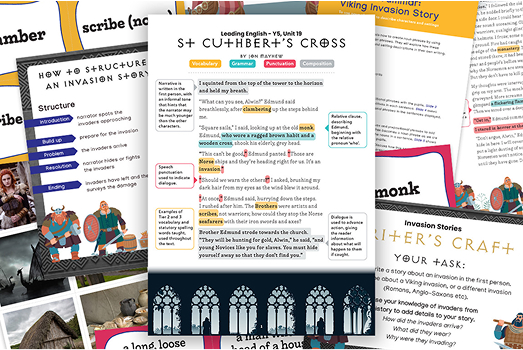
A recent review with a Leading English school demonstrated this impact. The school introduced the Leading English curriculum to strengthen progression, sequencing and quality of writing outcomes.
At the point of review, after two terms of implementation, leaders identified “there is now a really clear consistency” in teacher planning from Year 1 to Year 6.
Improved coherence and sequencing helped secure solid progress for pupils, with written outcomes across the school now described as “longer, better constructed and more complete than ever before.”
This success story illustrates the benefits of moving beyond isolated writing tasks toward a clearer, more coherent structure for teaching writing over time.
What changed?
One of the most significant improvements identified was that teachers were following the medium-term plans more closely because of the careful consideration for the small steps of progress.
This meant pupils were receiving a more coherent sequence of learning, rather than writing experiences that depended too heavily on individual teacher preference or confidence.
The review also found that teachers were becoming more aware of year-group expectations.
Moderation practices had developed, professional conversations were stronger, and assessment frameworks were helping teachers think more clearly about what pupils should be achieving by the end of a unit.
This is a key part of effective implementation. Writing improves when teachers are not just asking, “What activity are pupils undertaking today?” but “What learning is this activity designed to secure?”
Pupil engagement
This shift in focus was evident in the same school where target stickers became more learning-focused rather than activity-focused. This may sound like a small change, but it reflected a deeper shift in thinking.
When feedback and assessment are linked to the intended learning, pupils are more likely to understand what they need to improve as writers.
The review also identified stronger pupil engagement. Notably, some pupils were keen to talk about model texts unprompted, which leaders described as unusual.
Pupils were engaging particularly well with stories by children’s author Jon Mayhew, making links to his wider work.
The texts were found to be accessible yet ambitious in language, ensuring that meaning was preserved while maintaining high standards. Achieving this balance is a critical component of ongoing success.
If texts are too simple, pupils are not exposed to the language and structure they need to grow as writers. If they’re inaccessible, pupils may disengage or imitate surface features without understanding.
Strong model texts give pupils something rich to draw from, while still allowing them to understand, discuss and internalise the writing.
Why this matters for pupils who fall behind
This kind of improvement is especially important for pupils at risk of falling behind.
Disadvantaged pupils, pupils with weaker language development, pupils with SEND and less confident writers often need the curriculum to be particularly clear.
They benefit from strong models, explicit vocabulary teaching, oral rehearsal, shared writing and carefully sequenced steps towards independence.
The Leading English approach supports these pupils by integrating inclusive practice directly into curriculum design, rather than treating it as an add-on. Key benefits include:
- Clarity: A clear sequence reduces a pupil’s dependence on chance.
- Strong modelling: High-quality model texts provide better examples for pupils to draw from.
- Precise support: When teachers understand the progression, they can provide more targeted assistance.
- Effective assessment: Linking assessment to learning allows for quicker resolution of misconceptions.
- Instructional shared writing: Effective shared and modelled writing helps pupils understand the choices writers make.
This is why a coherent writing curriculum can raise the floor without lowering the ceiling. It helps more pupils access ambitious writing.
Once the curriculum is secure, leaders and teachers can ask sharper questions to evaluate progress:
- Are pupils keeping up with the intended sequence?
- Do teachers know when and how to adapt?
- Are misconceptions being identified early enough?
- Do pupils have the vocabulary needed to write successfully?
- Are scaffolds helping pupils think, or simply helping them complete the task?
- Are pupils becoming more independent over time?
These are the questions that move a school from better coverage to deeper impact.
The Leading English approach
Leading English supports schools to improve writing by bringing curriculum, pedagogy and assessment together.
The approach helps schools establish a clear, coherent writing curriculum while also strengthening the teaching practices that enable pupils to access it successfully. This includes:
- clear medium-term plans that support progression and sequencing
- high-quality model texts that expose pupils to ambitious language and structure
- explicit attention to vocabulary, sentence construction and composition
- modelled and shared writing that helps pupils understand how writers think
- formative assessment that helps teachers identify misconceptions in real time
- purposeful scaffolding that supports access without reducing ambition
- assessment frameworks that help teachers understand year-group expectations
- professional conversations that move teachers from activity completion to learning impact
The real strength of the approach is that it gives schools both structure and professional direction.
It supports consistency, but it doesn’t stop there. It helps teachers understand the “why” behind the sequence, so they can make better decisions in the classroom.
That is what leads to sustainable improvement.
Whole-school impact
In the school reviewed, the impact was visible in several ways:
• stronger consistency from Year 1 to Year 6
• improved coherence and sequencing
• longer and better-constructed written outcomes
• stronger moderation practices
• more learning-focused assessment
• improved teacher awareness of standards
• pupils engaging more confidently with model texts
It’s about creating a clear, structured improvement journey where teachers build confidence, pupils produce stronger writing and leaders can easily identify the next stages of refinement.
The result is pupils who are more likely to keep up because writing is taught through a curriculum that is coherent, ambitious, responsive and inclusive by design.
For schools reviewing writing this term, the key question is not simply “Are teachers following the plan?” Instead, the more impactful question is this: “Is the plan helping teachers teach writing better, and are pupils becoming more successful writers as a result?”
In schools using Leading English effectively, the answer is increasingly yes.