The strategic development of foundational writing is ‘Q2’ work, and that’s exactly why it gets neglected. Some leaders may know Stephen Covey’s Time Management Matrix. But very few apply it to curriculum leadership. Covey’s model is simple – all work falls into four categories:
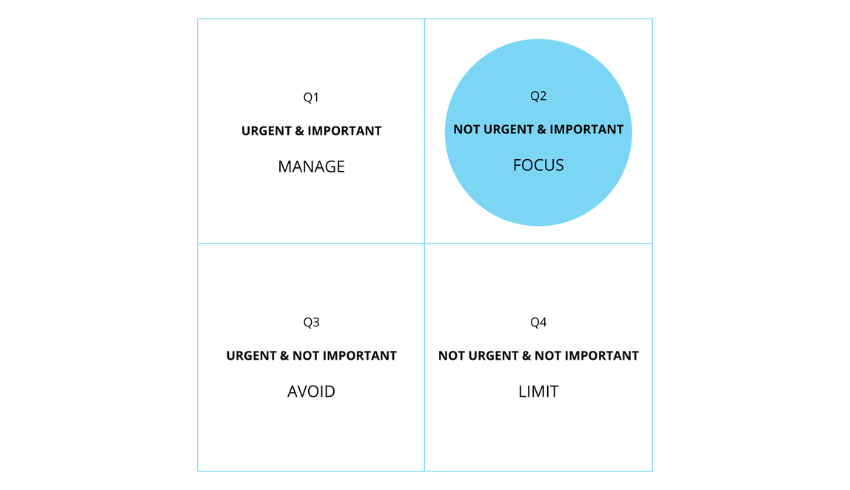
The insight that changes everything is that high-impact leadership happens in Quadrant 2.
Writing improvement lives in Q2
Strategic development of foundational writing learning is rarely urgent. No alarm sounds when sentence construction weakens in Year 4. No red light flashes when vocabulary becomes repetitive in Year 5.
The erosion is slow, subtle and invisible, until outcomes reveal it. By then, writing has moved into Quadrant 1 – emergency moderation; rapid CPD; data reviews; outcome pressure; talk of quick, reactive fixes.
But by its nature, foundational writing is preventative work. It is Quadrant 2. And if leaders do not deliberately protect it, it will always be crowded out.
The leadership tension
Here’s the real challenge. Leaders know foundational work matters, but they also know:
There is no spare release time
Staff are tired
Agendas are already full
Competing priorities are real
So Quadrant 2 work gets postponed until after the data drop or inspection. But delaying Quadrant 2 work can later cause a Quadrant 1 crisis.
What Quadrant 2 writing leadership actually looks like
It’s not grand or expensive. Instead, it’s deliberate. Here’s what we see in schools that move writing from reactive to strategic.
1. They clarify year group purpose
Instead of asking, “Have we covered enough genres?” they ask:
What must be secure in Year 3 that Year 6 depends on?
Are sentence foundations actively strengthened in KS2?
What does editing mean in each phase?
This conversation doesn’t require release time. It simply requires one protected agenda item. One meeting; one focused discussion – that’s Quadrant 2.
2. They protect sentence-level thinking in KS2
Foundational writing is not a KS1 issue. In schools where writing is strong, sentence construction is still being actively refined in Year 5 and Year 6. Not as drills, but as deliberate modelling.
Exploring how conjunction choice shifts emphasis or how clause placement changes rhythm takes minutes inside a lesson, but it changes pupil ownership.
3. They use CPD to build understanding, not deliver units
Quadrant 1 CPD sounds like: “Here’s the next unit.” Meanwhile, Quadrant 2 CPD sounds like:
Why this knowledge now?
What misconception are we anticipating?
How does this build on last term’s foundations?
It’s the same staff meeting but with a different lens. That shift builds expertise – and confidence.
What happens when writing stays in Quadrant 1
We see this too often. Pupils can write at length but can’t explain their choices. Editing becomes correction rather than reflection. Vocabulary becomes inserted rather than selected.
KS2 teachers assume foundations are secure. And leaders feel permanently one step behind. Covey would say that you’re living in Quadrant 1.
The real shift
Covey’s matrix asks one uncomfortable question: are you spending your best energy on your most important work?
If foundational writing knowledge is not secure across your school, particularly in KS2, then the most important work is not adding another initiative. Instead, it’s protecting Quadrant 2 thinking, clarifying progression, strengthening sentence mastery and deepening professional learning.
When that happens, something shifts. Pupils start to talk about writing with confidence. Editing becomes purposeful and vocabulary becomes precise. Outcomes improve – because understanding improves.
A final reflection
Quadrant 1 leadership feels busy, but Quadrant 2 leadership feels intentional. Foundational writing belongs in Quadrant 2. If we wait until it becomes urgent, we are already too late.
What Leading English does differently
Leading English exists to help schools move writing into Quadrant 2 and keep it there. We don’t sell quick fixes. What we do is build strategic clarity. Our work focuses on:
Mapping foundational writing progression from EYFS to Year 6
Securing sentence mastery across KS2
Embedding grammar and vocabulary for meaning
Aligning curriculum, pedagogy and assessment
Developing leaders and teachers through in-school professional learning
Crucially, we do this within existing structures. We work with schools based on your:
Staff meetings
Planning time
Monitoring cycle
Leadership rhythms
There’s no additional release time required, just sharper prioritisation. If you want to move writing from reactive to strategic – and build mastery that lasts – we would love to work with you.