National messaging around assessment is noisy again. The Curriculum & Assessment Review tells us not to be “data-driven”. The new Ofsted framework tells us that achievement must be evidenced.
Teachers hear: “Don’t collect data, but show impact.” Leaders hear: “Don’t rely on numbers, but results must improve.”
It’s inconsistent, confusing and, ultimately, unhelpful.
But beneath the noise is a truth that matters: when the system sends mixed signals, school and subject leaders must bring clarity. And assessment – used well – is one of the most powerful tools you have to do exactly that.
Assessment is noticing, not just numbers
Assessment isn’t just a spreadsheet or an MIS export. It isn’t a bureaucratic hurdle or an accountability mechanism. Assessment is the disciplined act of noticing learning – seeing the small steps, the subtle shifts and the moments where teaching and learning meet.
Understanding that connection is a huge part of leadership.
Data can show progress – but it can’t explain it
Let’s be clear: writing progress can absolutely be seen in data. You’ll spot patterns, see outcomes rise, watch independence build. But data can’t tell you:
- which scaffold unlocked access
- whether sentence control is developing
- which grammar step is visible in the draft
- where stamina or fluency broke down
- how teacher modelling shaped a choice
which pupils made deliberate vocabulary decisions
Numbers show movement. Assessment shows meaning. And in English – where learning is cumulative, complex and often beautifully subtle – that distinction is crucial.
Assessment must focus on where learning becomes visible
Assessment won’t hand you answers. But it will prompt better questions. And better questions improve teaching.
When assessment is used well, it shifts practice – not through pressure or monitoring, but through professional curiosity.
Assessment is professional noticing. Professional noticing builds professional judgement. Professional judgement improves teaching. Teaching improves outcomes.
(Yes – I’ll admit it – I love a number. But it’s the beginning of understanding, not the end.)
High-leverage assessment questions for English leads
- What exactly did pupils learn here? (Not just what they did – learning clarity)
- Where can we see sentence control emerging? (Sentence-level progress)
- How did the planning process shape writing decisions? (Cognitive process → writing behaviour)
- What changed in the redraft, and what caused that change? (Improvement as evidence)
- What feedback shaped this draft – and is it visible? (Instructional impact)
- Does the writing match the intended audience and purpose? (Purposeful writing)
- How is vocabulary used to clarify, connect or deepen meaning? (Lexical precision)
- What barrier did this pupil face – and what evidence shows it? (Inclusion through assessment)
- What routine or modelling moment supported progress? (Teaching consistency)
- What should the next lesson focus on? (Actionable next steps)
Why this matters now
The Curriculum & Assessment Review says assessment should strengthen teaching, not distort it. The new Ofsted framework says achievement must be understood through what pupils know and can do, not just what they can recall.
When English leads use assessment as a leadership tool:
- teaching becomes more responsive
- curriculum becomes more coherent
- progress becomes more visible – in books and in data
- inclusion becomes more consistent
workload reduces
Assessment isn’t the last step. It’s woven through everything we do. It’s how leaders bring clarity in a confusing moment. And clarity is what improves outcomes.
How Leading English can help
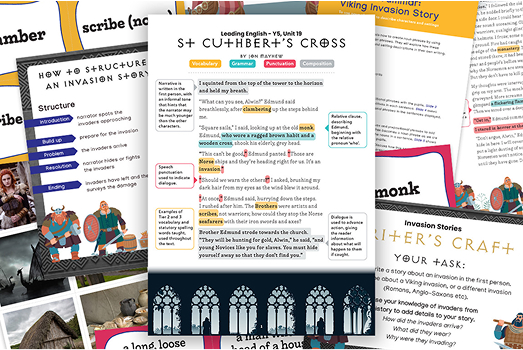
At Leading English, we help subject leaders move from overwhelm to clarity with a complete writing curriculum built on coherence, consistency and high expectations.
Every unit is designed around the principles you’ve read about today:
- learning made visible
- grammar taught in context
- purposeful model texts
- structured planning
- clear routines
- assessment that boosts teaching, not workload
Schools tell us the impact is immediate: greater teacher confidence, more writing happening, clearer progression and stronger, more inclusive outcomes.